
Every protest ends on a highway in Punjab, and commuters pay the price
 Aayush Goel
Published
Updated
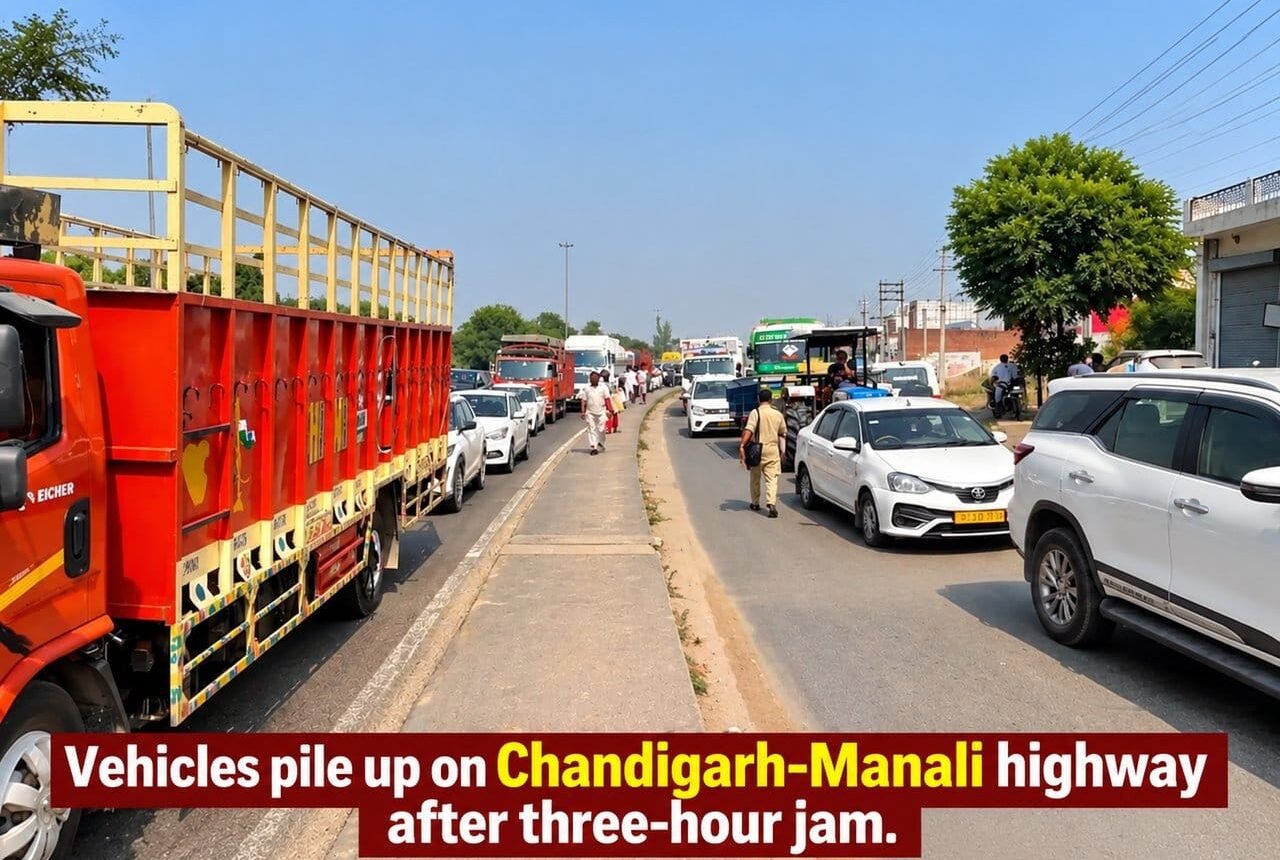
CHANDIGARH. Farmers blocked the Chandigarh-Manali highway at Ropar for nearly three hours on Tuesday, leaving trucks, buses and cars stuck on both sides.
Their anger: sheller owners want to cut 5 kg from every quintal of hybrid paddy. Farmers called it “loot.” Taranveer Singh Sidhu of BKU (Behramke) said officials had sat on the problem for nearly three weeks, and warned of a bigger stir. Officials reached the spot and promised vehicles to lift paddy from the mandi. Just a week earlier, Food and Civil Supplies Minister Lal Chand Kataruchak had promised that the government would buy every grain.
For commuters, it was nothing new. In seven weeks, almost every grievance in Punjab has ended up on a highway: Sikh prisoners, power cuts, a damaged statue, even a campus rumour.
The script rarely changes. Protesters take the road, police push traffic onto village lanes, and officials arrive with assurances only after vehicles pile up. By then, ambulances are stuck, families are stranded on the way to weddings and travellers are lost on unfamiliar detours. Their losses rarely come up at the table.
August 21: bandh shuts Punjab roads
The Qaumi Insaf Morcha’s bandh for the release of Sikh prisoners caught office-goers and travellers in blockades in Patiala, Mohali, Jalandhar and beyond. Mohali’s Airport Road was blocked and Mohali-Chandigarh cabs stopped till afternoon. Roads from Jalandhar to Amritsar, Ludhiana, Pathankot and Kapurthala were shut, and nearly 7,500 private schools stayed closed.
Power cuts push farmers onto roads
In early September, farmers angry over erratic tubewell supply blocked the Bathinda-Faridkot highway and the Baghapurana-Kotkapura road, then the Barnala-Mansa road at Pakho Kalan the next day. They accused the AAP government of breaking its promise of eight-hour power during the paddy season.
BKU (Doaba) threatened to block the Behram toll plaza from September 12, and BKU (Lakhowal) threatened to shut the GT Road in Jalandhar.
On September 14, industrialists and farmers blocked the Ludhiana-Chandigarh highway at Vardhman Chowk for an hour over power outages, choking every road leading to the chowk.
NH-44 shut for four hours in Ludhiana
On September 9, hundreds blocked NH-44 at the Jalandhar Bypass chowk for four hours over the desecration of a Dr BR Ambedkar statue. Protesters raised slogans against the AAP and blackened the signboard of local AAP MLA Madan Lal Bagga, warning he would pay for it in the coming elections.
One family was stuck on its way to a wedding in Jammu. Commuter Arjun Arora asked “why commuters are being harassed” when the government cannot settle protesters’ issues.
Students block Jalandhar highway
On September 27, LPU students protested over an unverified report of an assault on a female student. Traffic on the Phagwara-Jalandhar highway stopped, hitting travellers bound for Amritsar, Pathankot, Gurdaspur and Jammu and Kashmir.
A diversion and little else
At LPU, police sent traffic onto village roads not built for it, and drivers got lost. On NH-44, only ambulances, school vans and emergency vehicles got through. On the Ludhiana-Chandigarh highway, police had to clear a path for ambulances stuck in the jam.
Even planned protests found little done for road users. Five days before the August 21 bandh, the Bhagwant Mann government had not responded to the call. On the day, the focus was security, with SP-rank officers posted at every major protest point in Bathinda.
Blocking the road pays off
For protesters, the highway works. Near Goniana, a blockade ended late at night once the power corporation promised supply. In Ludhiana, the statue protest ended with a memorandum and a meeting date. Earlier this year, transporters held the Manali highway near Kiratpur Sahib for about seven hours, until AAP minister Harjot Singh Bains came to the dharna.
Police cases are rare. After the September 14 jam, Ludhiana police booked the Punjab Dyers Association president and 250 others. He said the power problem was solved “after the protest.”
Courts have warned before
In a midnight hearing on a farmer blockade of NH-44, the Punjab and Haryana High Court said a few people cannot curb citizens’ right to move freely, and that the district administration should have acted at once.
Poll season raises the stakes
With assembly polls due early next year, the AAP government faces a hard choice: cracking down on farmers, Sikh bodies or Dalit groups is a political risk. Yet the state has acted when it chose to. In March 2025, police bulldozed the Shambhu and Khanauri protest sites, and Finance Minister Harpal Cheema cited the state’s economic growth.
What has not changed is the commuter’s lot. Seven weeks of jams have brought protesters quick assurances, while road users have got little more than diversions.
The state government has so far issued no statement regarding the frequent blockades and subsequent inconvenience.
Until that changes, the commuter stuck between two lines of trucks must find his own way home.
Comments