
Punjab owes ₹32,418 crore to employees, pensioners: Will DA anger cost AAP in 2027?
 Aayush Goel
Published
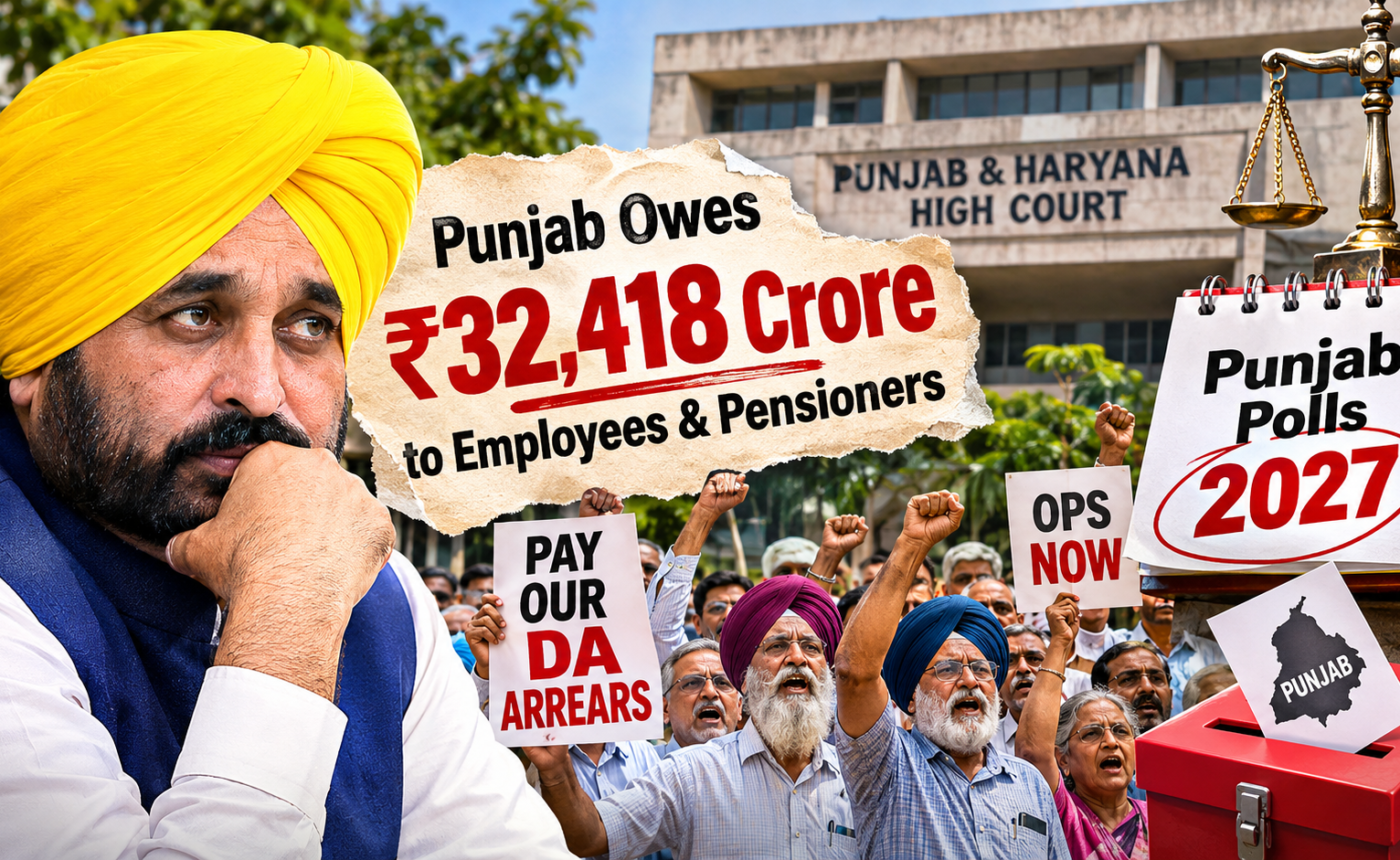
CHANDIGARH: Punjab has told the High Court on affidavit that its unpaid bill to serving staff and retirees has climbed to about ₹32,418 crore. The sum is roughly three and a half times what the state has budgeted this year for its monthly cash scheme for women.
The biggest chunk, ₹22,818 crore, is arrears of dearness allowance (DA) due to employees and dearness relief (DR) due to pensioners. Chief Secretary KAP Sinha filed the affidavit before the Punjab and Haryana High Court.
The state has also owned up to its duty to pay these arrears with 6% interest a year, in line with the High Court’s August 3 verdict. With no stay from the Supreme Court on that verdict, the order still binds the government.
Nearly 7.5 lakh people wait for the money: over 3.5 lakh regular employees and more than 4 lakh pensioners. Punjab goes to the polls in February 2027. Sinha must be present in court in person on November 3.
₹8,627 crore more than the SC figure
The amount has swelled fast. When Punjab moved the Supreme Court in September, it said ₹14,191 crore could not be paid within 15 days. The affidavit now pegs DA and DR arrears at ₹8,627 crore above that figure.
Officers get more, staff wait
The fight is about two pay scales in one state. IAS, IPS and IFS officers posted in Punjab already draw DA at the Centre’s rate. The High Court wants state staff and pensioners paid at that same rate.
Punjab has only partly closed the gap. On September 18, a meeting chaired by Chief Minister Bhagwant Mann cleared an 8 percentage-point increase. Five days later, the finance department raised DA from 42% to 50%, effective September 1, 2026. Staff and pensioners received the new rate with September’s pay and pension, released in October.
Neighbouring Haryana and Rajasthan already pay 60%, the Central rate. Even within Punjab, a cabinet panel has proposed 60% for about 85,000 staff hired after July 17, 2020.
Full parity with the Centre would cost the state about ₹4,712 crore more every year, the government told the court. Salaries and pensions took about ₹58,064 crore in 2025-26. The state said it may need a separate budget provision to clear the backlog.
A year in court
The case has moved through three courtrooms in six months. On April 8, a single judge asked the state to clear DA arrears by June 30, 2026. The judge also quashed the government’s plan to pay pensioners in phases based on age, calling it arbitrary and a breach of the right to equality.
The state’s appeal failed. On August 3, a division bench gave it 15 days to pay.
Punjab then filed a special leave petition in the Supreme Court on September 1. The apex court registry found procedural flaws. The state filed it afresh on October 1.
That delay put Sinha in the dock. The High Court found that what he said about the appeal did not match the registry’s record of pending defects. A division bench is now hearing criminal contempt proceedings against him over the alleged false statement. On October 28, the court also slapped ₹1 lakh in costs on him for not filing a compliance report.
In the fresh affidavit, the state denied that the delay was deliberate disobedience. Sinha assured the court that the government honours judicial orders and accepts that it must pay, with interest.
35,000 pensioners did not live to see it
For many retirees, the wait has outlasted their lives. Lawyers for the petitioners told the court that over 35,000 pensioners have died since January 1, 2016, without getting their arrears.
Unpaid DA is an old problem in Punjab. Instalments due from January 2017, June 2017 and January 2018 were held back under the previous Congress government too.
Pensions add to the grievance. The Mann cabinet cleared a return to the Old Pension Scheme (OPS) in November 2022. Nearly four years on, employees say it has not been rolled out. “The government had given us a guarantee,” said Jasvir Singh Talwar, state convener of an OPS forum.
Anger on the streets
Tempers boiled over this summer. On August 27, over three lakh employees took mass casual leave across the state. In Amritsar, patients stood outside the locked OPD of Guru Nanak hospital. In Patiala, marching staff pushed through barricades on their way to minister Balbir Singh’s house.
Union leaders said AAP had promised before 2022 to settle their demands first, and warned the party to brace for the result at the ballot box. The strike ended in September after talks with Sinha. Employee groups are now setting up district-level political cells ahead of 2027.
What it means at the ballot box
On paper, 7.5 lakh employees and pensioners are about 3.7% of Punjab’s 2.01 crore voters on the final roll.
Families change the count. At an average of three voters per household, the bloc could add up to about 22 lakh votes, close to 11% of the electorate. Spread across 117 seats, that is about 19,000 votes per constituency. These are broad estimates, but they explain why no party can ignore this group.
Recent elections show the risk. In Himachal Pradesh in 2022, Congress promised the old pension to about four lakh serving and retired staff and won 40 of 68 seats. Ashok Gehlot, then Rajasthan chief minister, credited the pension promise for the win.
Earlier this year in West Bengal, the BJP won 206 seats and ended 15 years of TMC rule. Pending DA was among the grievances of state employees there.
Opposition parties are already working the issue. Punjab BJP chief Sunil Jakhar pointed to Bengal and said Punjab’s staff were watching. “DA is not charity,” he said. Leader of Opposition Partap Singh Bajwa asked the government: “Do you not want to give DA?” Akali Dal chief Sukhbir Badal has promised to clear all DA arrears at once if his party wins.
AAP is relying on a much larger vote bank. Its scheme pays ₹1,000 a month to women and ₹1,500 to Scheduled Caste women. About 52 lakh women were expected to get it in the first phase. Critics say the government has chosen women voters over employees and pensioners.
Finance Minister Harpal Singh Cheema has played it cool. Asked about the poll impact, he said organisations have a right to raise demands, election or no election.
Money is the real constraint. Salaries, pensions and interest will eat up ₹90,335 crore in 2026-27, or 72% of the state’s revenue receipts. Punjab’s debt is projected at ₹4.47 lakh crore by the end of the financial year.
AAP has a lot riding on Punjab. After losing Delhi, it is the only state the party governs. It swept 2022 with about 42% of the vote. Employees cannot swing the election on their own. But in a four-way fight, a shift among some 20 lakh family voters could decide close seats.


Comments