
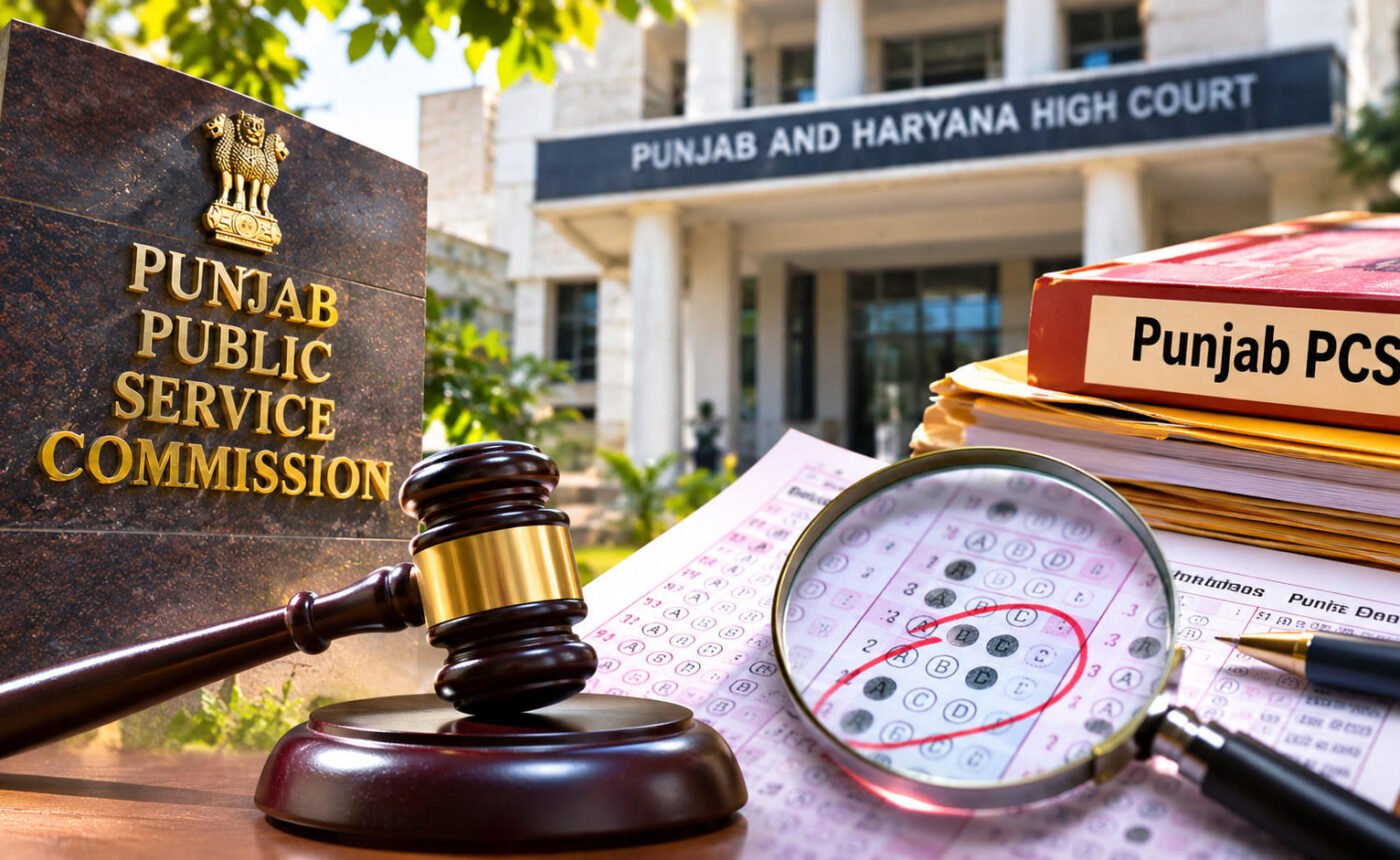
Punjab PCS mains result 2026 row: candidates move High Court, PPSC chief says results normal
 Aayush Goel
Published
Chandigarh. Candidates who took the Punjab civil services mains exam went to the Punjab and Haryana High Court on Thursday, alleging rigging in a result that put up to 11 candidates from a single exam room on the interview list. The Punjab Public Service Commission (PPSC) chairman has rejected the charge and called the results statistically normal.
The PPSC declared the mains result late on Wednesday night. It called 751 candidates for interview against 331 posts. Within hours, candidates were circulating room-wise and roll number-wise analyses of the list. They alleged irregularities in the evaluation of answer sheets.
Before going to court, the candidates emailed a memorandum to the President, the Prime Minister, Chief Minister Bhagwant Mann and the CBI seeking an independent probe. When they got no satisfactory response, they filed a petition in the high court on Thursday. Groups of candidates gathered in the high court parking area through the day.
PPSC chairman Maj Gen Vinayak Saini (retd) defended the result. “These results are exactly what statistics would normally produce,” he said. “The claim that 24% of candidates passed from one centre is being presented the wrong way.”
The opposition has seized on the issue. The BJP compared it to the NEET paper leak and demanded a CBI probe. Congress leader Amarinder Singh Raja Warring asked CM Mann when his government would answer.
The numbers behind the charge
Candidates say one room at each of four different centres produced 10 or more shortlisted candidates:
– Centre 7, Room 8: 11 of 24 candidates (45.8%)
– Centre 11, Room 14: 10 of 24 (41.7%)
– Centre 4, Room 19: 10 of 24 (41.7%)
“So many candidates clearing from one room cannot be a coincidence,” the candidates have said.
They also point to wide gaps between and within centres. Centre 8 recorded an overall shortlisting rate of 24.21%. At Centre 1, rooms 1 to 7 recorded only 2.89%, but the rate rose to 13.77% in rooms 8 to 18.
A roll number-wise breakdown shows the same uneven spread. Out of every block of 500 roll numbers, 39 candidates (8%) cleared from the 10000-10499 block, while 111 (22%) cleared from the 12500-12999 block.
Neighbours on the list
The sharpest charge concerns consecutive roll numbers. A document shared by candidates lists 26 groups of back-to-back roll numbers among those shortlisted, covering 86 candidates. It counts 22 groups of three, two groups of four and two groups of six. One cluster runs 11559, 11560, 11561, 11562, 11564 and 11565.
Candidates say roll numbers are allotted according to the seating plan. They argue that when candidates seated in the same row clear together, it casts doubt on fairness.
They have also alleged that roll numbers of some candidates who were absent from the exam appear on the shortlist.
Interview list, evaluators, Patiala centres
Under recruitment rules, the commission calls three times as many candidates as there are posts for interview. For 331 posts, that would be 993 candidates. The commission called 751. Candidates say no official reason has been given for the shortfall.
Candidates also allege that university students, not professors or subject experts, checked the answer sheets. They further claim some people knew in advance how many answer sheets they would be given to evaluate. They have also questioned why every exam centre was set up in Patiala.
In July, Saini had said the commission had “engaged evaluators who are experts in their respective fields” to ensure a fair assessment.
What candidates want
The candidates have listed seven demands:
– a stay on interviews based on the mains result
– sealing of all original answer sheets, digital logs, evaluation records and attendance registers
– a forensic audit of evaluation, moderation and marks compilation, under an independent agency or a retired judge
– a probe by a central agency
– public release of category-wise and centre-wise cut-offs and shortlisting data
– disclosure of evaluators’ qualifications, appointment process and answer-sheet allotment records
– strict legal and administrative action if wrongdoing is proved
BJP compares it to NEET leak
Former Punjab BJP president Sunil Jakhar listed the PCS result as the latest in a series of disputed recruitment exams. “First the Naib Tehsildar exam paper leaked, then the paramedical staff recruitment paper at Baba Farid University of Health Sciences, and now the PCS exam has been hijacked through alleged rigging in the PPSC mains,” he wrote on social media. “How is this any different from the NEET paper leak? Let Punjab’s youth decide.”
He said the result had exposed the Mann government’s promise of “jobs without money, without recommendation”. He also asked: “Was the whole setting done when the roll numbers were issued? Were consecutive roll numbers given to favoured candidates as part of a plan?”
“This is about the dreams and the future of Punjab’s youth,” Jakhar said. “A CBI probe is absolutely necessary so the truth comes out.”
BJP leader and former Union minister of state Ravneet Singh Bittu called for interviews to be put on hold. “Big claims of merit and transparency are made from stages,” he said. “But when selections come only from particular rooms and particular serial numbers, it looks like a betrayal of hardworking youth. If the government is honest, it should halt interviews, seal the answer sheets and order a probe by an independent agency or the CBI.”
At a press conference in Delhi, BJP national spokesperson Pradeep Bhandari said, “A paper leak mafia is operating in Punjab.” He alleged the AAP government was shielding it. Bhandari also claimed that the centre with the high selection rate falls in an AAP MLA’s constituency.
BJP Punjab vice-president Subhash Sharma asked for exam centre records, attendance registers, answer sheets and roll number allocation records to be made public.
Congress: ‘When will we get an answer?’
Ludhiana MP and former Punjab Congress chief Amarinder Singh Raja Warring said the PCS mains results had raised serious questions about the transparency of Punjab’s recruitment system.
“The questions raised by candidates are very serious,” Warring said. “The PPSC chairman should answer publicly, and CM Bhagwant Mann should order an independent probe at once.”
He asked for the original answer books, digital records and evaluation process to be secured, and for a forensic audit of the whole selection process. “The rights of Punjab’s hardworking youth must not be sacrificed to influence or alleged rigging,” he said. “Bhagwant Mann, the question is now for your government. When will we get an answer?”
The Punjab government and AAP had not responded to the opposition’s charges by the time of filing this report.
The exam so far
The PPSC held the preliminary exam for the 331 posts on December 7, 2025, and declared its result on January 10, 2026. The mains exam was held from April 1 to 10, 2026. The commission had earlier said it would take extra time to declare a result that was beyond question.
Comments